How to Keep a Real Christmas Tree Fresh Through to January: The Fresh Cut, the Water Level and the Species That Decide It
A cut tree is a drinking stem, not a decoration. Whether it lasts until January is settled in the first 24 hours: one clean cut, a stand big enough, and water that never drops below the trunk.
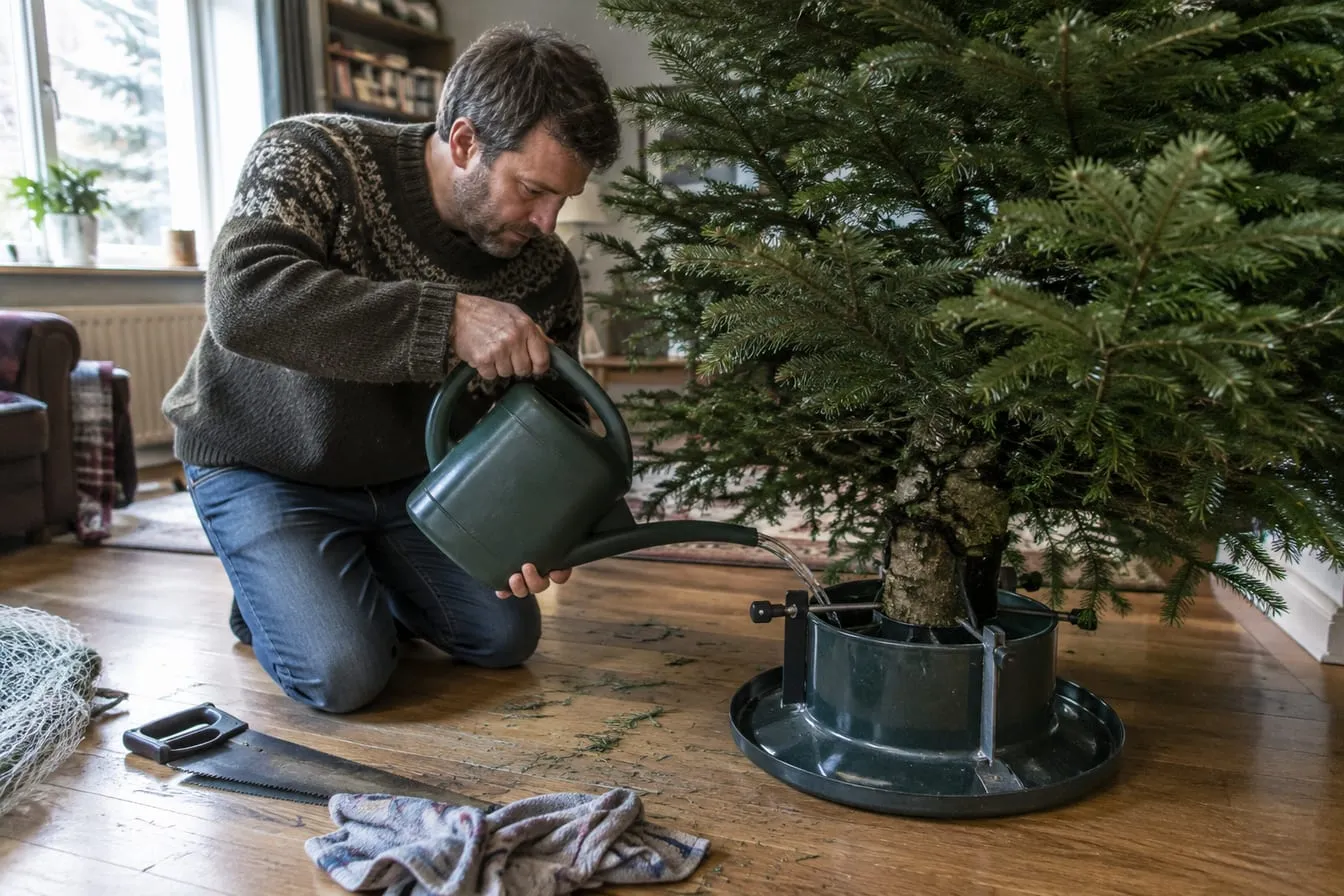
Recut the trunk, stand it in water, never let it run dry
To keep a real Christmas tree fresh, saw a 1 to 2 cm disc straight off the base of the trunk unless it was felled within the last 6 to 8 hours, put it into a stand that holds about 1 litre of water for every 2.5 cm of trunk diameter, and keep that water topped up so it always covers the cut. Keep the tree at least a metre from radiators and fires. Buy a species that holds its needles, such as a Nordmann or Fraser fir. Everything else is detail around those four points.
The reason is plain plant physiology. A cut conifer is a stem with no roots, and it keeps its needles only as long as it can replace the water they lose. Water travels up through the outer sapwood of the trunk, just under the bark. When the cut end is exposed to air, resin oozes out and hardens over it, much as a scab forms on skin, and air is drawn into the water-conducting cells. Once that happens, the tree in your living room may stand in a full stand and drink almost nothing.
A tree that is drinking will lose a few litres from the stand over its first days indoors. A tree whose stand level barely moves is not "needing less water"; it is usually sealed.
Choose a species that holds its needles
Care decides how long a tree lasts, but species sets the ceiling. A Norway spruce cared for perfectly will still shed earlier than a Nordmann fir cared for moderately well. These are the trees most commonly sold for Christmas in Britain, Europe and North America, and how they behave in a heated home.
| Species | Needle retention indoors | Needles | Scent | Notes |
|---|---|---|---|---|
| Nordmann fir (Abies nordmanniana) | Excellent, often 5 weeks or more | Soft, flat, glossy, not sharp | Faint | The UK's best-seller; strong branches |
| Fraser fir (Abies fraseri) | Excellent, 4 to 5 weeks | Short, soft, silver underside | Pleasant, moderate | Narrower shape suits small rooms; common in the US |
| Noble fir (Abies procera) | Excellent, 5 weeks or more | Blue-green, curved upwards | Mild | Stiff, well-spaced tiers for heavy ornaments |
| Scots pine (Pinus sylvestris) | Very good, holds needles even when dry | Long, in pairs, slightly twisted | Strong, piney | Tough and cheap, less classic shape |
| Blue spruce (Picea pungens) | Moderate, 3 to 4 weeks | Very sharp, steel blue | Moderate | Striking colour, painful to decorate |
| Norway spruce (Picea abies) | Poor in warm rooms, 2 to 3 weeks | Short, sharp | Strong, classic | Cheapest; buy late, keep cool |
The pattern is consistent: firs (Abies) and pines hold on, spruces (Picea) let go. If you are not sure which tree you are looking at, the needles help. Fir needles are flat and soft and attach to the twig by a small round sucker; spruce needles are square in section, roll between your fingers and sit on little woody pegs that stay on the twig after the needle falls.
The comparison above sets the two most common choices side by side.
Check freshness before you pay
Many trees sold in December were felled in November, and some were cut weeks earlier and stored. A tree that has already lost much of its moisture will not recover, however well you water it. Before buying, check four things:
- Pull test. Grip a branch gently and draw your hand towards you along it. A fresh tree loses only a needle or two from the outer, green growth.
- Bend test. Fresh fir needles bend without snapping. Brittle needles that break cleanly mean the tree is already dry.
- Drop test. Lift the tree a few centimetres and drop the trunk onto the ground. A shower of brown needles from inside is normal, because conifers shed older inner needles every year. A shower of green ones from the outer branches is not.
- The cut end. A sticky, slightly moist cut with fresh resin suggests a recent felling. A grey, dry, cracked end suggests a long time since cutting.
Ask when the tree was felled. Farm shops, tree farms and pick-your-own plantations can usually tell you the day; a supermarket forecourt usually cannot. Buying from a grower is the single easiest way to start with a tree that has weeks of life in it.
Make the fresh cut, and how not to make it
If the tree was felled more than about 6 to 8 hours before it reaches water, which is nearly always the case for a bought tree, saw a disc of 1 to 2 cm off the base. Many sellers will do this for you as you leave with a powered saw; if the drive home and set-up takes more than a few hours, make another cut yourself. A sharp pruning saw or bow saw does it in under a minute.
Cut straight across, at a right angle to the trunk. Several old habits make things worse:
- No V-cuts or angled cuts. They do not increase water uptake in any measurable way and leave the tree wobbling in a stand designed for a flat base.
- No drilled holes in the side of the trunk. They do not help either.
- No shaving the bark to make the trunk fit the stand. The water-conducting sapwood sits just under the bark, and whittling it away removes the very tissue the tree drinks through. Buy a bigger stand instead.
Get the tree into water as soon as possible after cutting, ideally within an hour. If you are not ready to put it up indoors, stand the freshly cut trunk in a bucket of water in a cool, shaded place outside or in an unheated garage. Trees held like this keep well for several days before coming in.
Use a stand big enough, and fill it to the top
The most widely repeated guidance, from the US National Christmas Tree Association and many growers, is that a stand should hold about 1 litre of water for every 2.5 cm (one quart per inch) of trunk diameter. Most cheap stands are much smaller than that, which is why so many trees run dry on their second night.
| Trunk diameter | Typical tree height | Minimum reservoir | First-days daily uptake |
|---|---|---|---|
| 5 cm | About 1.2 to 1.5 m | 2 litres | Up to about 2 litres |
| 7.5 cm | About 1.5 to 1.8 m | 3 litres | Up to about 3 litres |
| 10 cm | About 1.8 to 2.1 m | 4 litres | Up to about 4 litres |
| 12.5 cm | About 2.1 to 2.4 m | 5 litres | Up to about 5 litres |
| 15 cm | About 2.4 to 3 m | 6 litres | Up to about 6 litres |
Trunk size varies by species and grower, so measure rather than guess from height. A water-holding stand with screw or ratchet clamps typically costs £20 to £60. A decorative stand that holds a cupful is not worth having however it looks, and a bucket of wet sand or gravel holds the tree but hides how much water is left.
Fill the stand to the top as soon as the tree is in and keep it there. The water must cover the base of the trunk at all times, with several centimetres to spare. A plastic watering can with a long spout, or a funnel and a length of tube, reaches the reservoir under the branches without sliding underneath on your stomach.
Water with plain tap water, and check twice a day
A freshly cut tree drinks hardest in its first days indoors, and a 2 m tree can take several litres in a day. Check the level every morning and evening for the first week, then at least once a day. Uptake slows after the first week or two but continues until the tree comes down.
Use ordinary tap water. Washington State University's Christmas tree research programme, and other trials since, have tested the popular additives, and plain water does as well as any of them:
- Sugar, corn syrup and lemonade feed bacteria and moulds in the reservoir rather than the tree, and can slime up the cut surface.
- Aspirin, bleach and vodka do nothing useful in the amounts people add.
- Commercial preservatives and fire retardant sprays gave no benefit in most trials, and some reduced water uptake.
- Warm or hot water for the first fill has no reliable benefit; cold tap water is fine.
- Misting the needles adds almost nothing, and spraying water near plugged-in lights is a bad idea.
If the stand does run dry, refill it at once. Many trees resume drinking, especially if the gap was only a few hours. If the level then stops falling over the next day, the base has probably sealed. Short of taking the tree down to recut it, you can only slow the decline: keep the room cool, keep the lights off when nobody is in, and plan to take it down earlier.
Place it away from heat and dry air
Once the tree is drinking, the next enemy is warmth. Warm, dry air pulls water out of the needles faster, and a tree that loses water faster than it can replace it dries out from the tips inward.
Keep the tree at least a metre from radiators, open fires, wood burners, heat vents and sunny south-facing glass. If the only space is beside a radiator, close that radiator's valve or turn its thermostatic head down while the tree is up. A cooler room, around 18 C rather than 22 C, lengthens a tree's life noticeably, and the difference is greatest with spruces. Heating and drying air are the same forces that drive the condensation that streams down cold windows in winter, seen from the other side: a warm room with little moisture in its air pulls water from whatever it can, needles included.
A netted tree needs a day to settle. Cut the netting from the bottom upwards once the tree is secure in the stand, and leave the branches to drop into shape before decorating. Some people let the tree adjust in a cool garage for a day first; that does no harm if the cut end stands in water.
Lights, fire risk and when to take it down
A well-watered tree is hard to set alight. A dry one burns very fast. Fire services in several countries stage demonstrations in which a dried-out tree is fully alight within about a minute. In the US, the National Fire Protection Association attributes an average of around 150 to 160 home fires a year to Christmas trees, with electrical faults, mainly lights, and heat sources placed too close among the leading causes. Watering is a safety measure as much as a cosmetic one.
- Use LED lights. They run much cooler than old incandescent sets and draw less power.
- Check every set before it goes on, and discard any with cracked bulbs, frayed cable or loose connections.
- Switch the lights off at night and when you go out. A plug-in timer makes this automatic.
- Never put candles on or near a tree.
When the tree starts dropping green needles from the outer branches whenever someone walks past, or the needles snap rather than bend, it is drying out. Take it down then, even if it is before Twelfth Night. Slip a large bag or an old sheet over it before you carry it out, and you lose far fewer needles in the hall.
Most UK councils collect real trees for chipping in the first weeks of January, and many charities run collections for a donation; elsewhere, garden waste services and municipal drop-off points do the same. Remove every bit of tinsel and every hook first, because they ruin compost. If you have a garden, the chipped or chopped branches make a free, slightly acidic mulch around rhododendrons and other acid-loving plants, and the Grow desk has more on putting the garden to bed for winter.
When to buy, what it costs, and what goes wrong
Timing. A well-chosen fir, recut and watered, typically stays in good condition for four to five weeks in a room around 18 to 20 C, so a tree bought in the first or second weekend of December comfortably reaches the New Year. Norway spruce is better bought in the week or so before Christmas. Earlier than late November is a gamble for any cut tree, because you cannot know how long ago it was felled.
Cost. In the UK, a 6 ft Nordmann fir typically sells for about £50 to £90, a Norway spruce of the same size for about £30 to £50, and prices are higher in cities and from small independent sellers. A proper water-holding stand adds £20 to £60 once and lasts for years. Against that, the cost of a tree that is brown by Christmas Eve is the whole price.
The failures are the same in house after house:
- No fresh cut after a long drive, so the tree never really starts drinking.
- A stand too small for the trunk, which empties overnight in the first week.
- Shaving the trunk to make it fit, removing the sapwood it drinks through.
- Placement beside a radiator or in a room kept warm for a party.
- Choosing a Norway spruce for a tree that goes up in early December.
- Trusting additives instead of checking the water level.
Honest expectations help too. Every real tree drops some needles, especially the older inner ones, and a few under the branches are normal. What a well-cut, well-watered fir should not do is turn crisp and bare at the tips before the presents are open.
By the numbers
- 1 to 2 cm
- Disc to saw off the trunk Needed if the tree was felled more than 6 to 8 hours ago.
- 1 L per 2.5 cm
- Stand capacity per inch of trunk A 10 cm trunk needs a reservoir of about 4 litres.
- Twice a day
- Water checks in the first week When a fresh tree drinks most and small stands empty overnight.
- 1 m
- Clearance from heat sources Radiators, fires, stoves and heat vents dry the needles fast.
Side by side
Nordmann fir vs Norway spruce
These are the two trees most buyers in the UK and much of Europe choose between. They look similar on the lot and behave very differently in a heated room.
Nordmann fir
- Flat, soft, glossy dark green needles that are not sharp to handle.
- Excellent needle retention: often four to five weeks or more indoors when watered.
- Little or no scent, which suits some households and disappoints others.
- Typically costs more, often around £50 to £90 for a 6 ft tree in the UK.
- Strong, evenly spaced branches carry heavy decorations well.
Norway spruce
- The traditional European tree, with the classic resinous Christmas smell.
- Poor needle retention in warm, dry rooms: shedding often starts within two to three weeks.
- Short, sharp needles that are unpleasant to handle and to hoover out of carpets.
- Usually cheaper, often around £30 to £50 for a 6 ft tree in the UK.
- Best bought late, kept in a cool room and taken down soon after Christmas.
Which to pick. If you put the tree up in early December, or the room is warm, buy a Nordmann fir and pay the difference. Norway spruce is good value and smells better, but only if it goes up close to Christmas and comes down soon after.
Still wondering
Questions readers ask next
How often should I water a real Christmas tree?
Check the stand every morning and evening for the first week, and at least once a day after that. A freshly cut tree can drink a litre or more a day in the first few days, and a small stand can empty overnight. Top up whenever the level falls, with the aim that the water always covers the base of the trunk by several centimetres. Uptake slows after the first week or two, but it does not stop.
Should I put sugar, aspirin or lemonade in Christmas tree water?
No. Trials at Washington State University and other research programmes have found that plain water keeps cut conifers fresh as well as, or better than, sugar, aspirin, bleach, corn syrup, lemonade and most commercial tree preservatives. Some additives reduce water uptake or feed bacteria in the reservoir. They also make the water more harmful to pets that drink from the stand. Tap water, kept topped up, is the whole method.
My Christmas tree stand ran dry. Is it ruined?
Not necessarily. Refill it straight away. Many trees start drinking again, especially if the stand was only dry for a few hours. If the level then stops falling over the next day, resin has probably sealed the base and the tree is no longer taking water. Recutting means taking the tree down, so most people accept a shorter life instead, keep the room cool and switch the lights off when nobody is there.
How long does a real Christmas tree last indoors?
A fresh fir bought from a reputable seller, recut and kept watered in a room around 18 to 20 C, typically stays in good condition for four to five weeks, and Nordmann and noble firs often longer. Norway spruce usually lasts two to three weeks before needle drop becomes a nuisance. A tree that was cut weeks before sale, or that runs dry, can decline in days.
Should I cut the bottom off a Christmas tree?
Yes, unless the tree was felled within the last 6 to 8 hours. Within hours, resin seeps out and seals the cut end, which blocks water uptake. Saw a disc of 1 to 2 cm straight across the trunk just before the tree goes into water. Do not cut a V, an angle or drill holes in the base: they do not improve uptake and make the tree harder to stand securely.
Is it safe to keep a real Christmas tree next to a radiator?
It is best avoided. Warm, dry air next to a radiator, fire, stove or heat vent makes the tree lose water faster than it can drink, so needles dry and drop sooner and the tree becomes more flammable. Aim for at least a metre of clear space from any heat source, and turn down or close the valve on a radiator right beside the tree if you cannot move it.
Read next
More from Grow
How to Lift, Dry and Store Dahlia Tubers Over Winter So They Wake Up Firm in Spring, Not Rotten or Shrivelled
Most dahlias lost over winter are not killed by cold. They rot in a damp box or dry to husks in a warm garage. The fix is a few degrees and a monthly look.

Planting Garlic in Autumn for Fat Bulbs Next Summer
Garlic is planted as the year closes and lifted at the height of summer. Get the cold, the depth and the drainage right in October, and the plant does most of the rest.

Beekeeping basics for a first healthy hive
A calm first season begins with the right colony, a site that works for bees and neighbours, and disciplined checks before varroa or swarming become emergencies.